
Powering Her Enterprise, Transforming Her Community
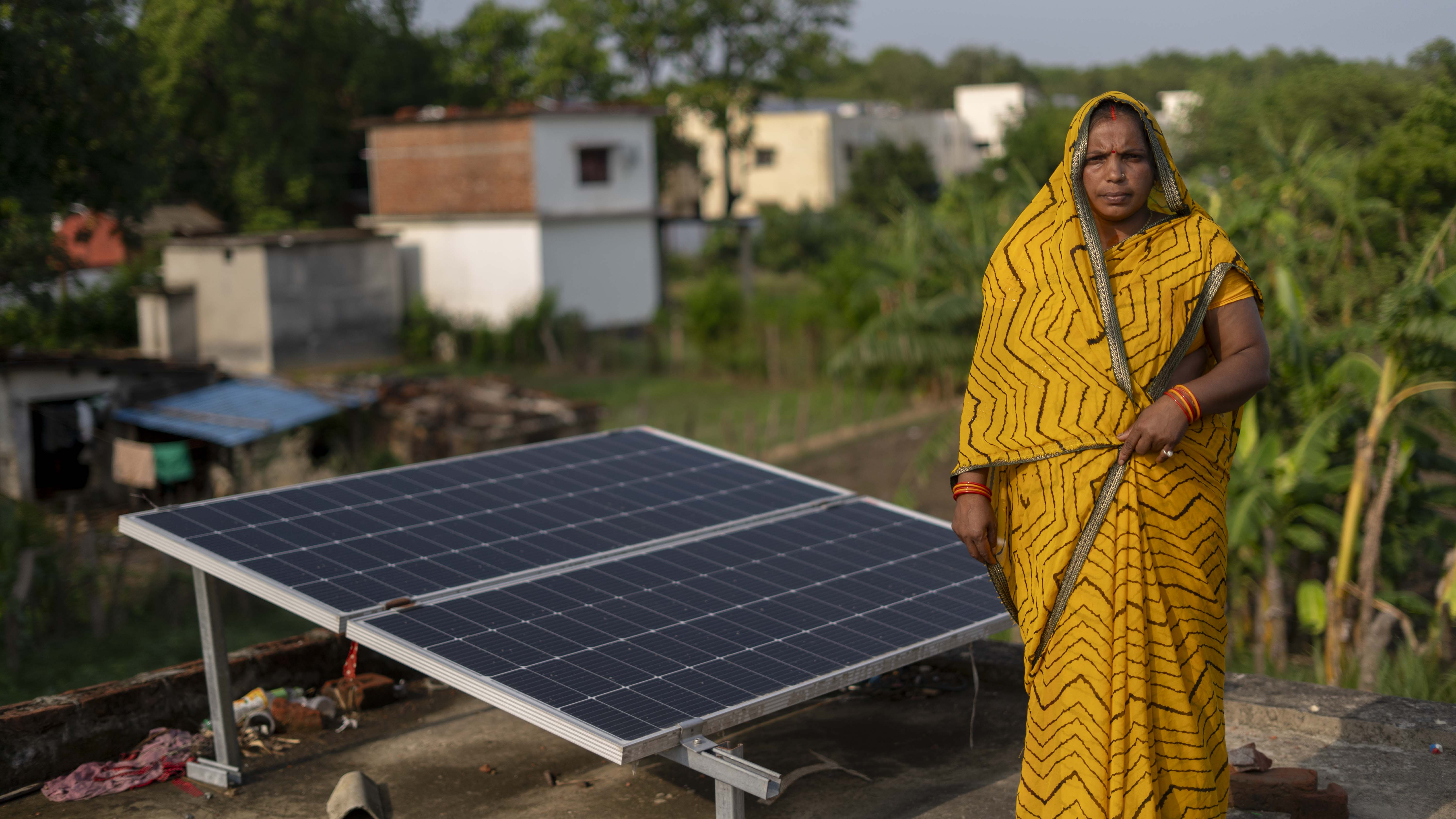
This is the story of Chanda’s General Store and how early adoption of solar energy has helped transform her source of livelihood into a place where other women’s work could find a market. It explores how solar energy and collective action is helping rural women like Chanda expand livelihoods, build markets, and strengthen economic agency in Uttar Pradesh.
“Ye sab iss gaon mein nahi chalega.”
(All this won’t work in this village.)
Chanda, a resident of a small village in Uttar Pradesh, had heard these words often.
As a resident of Rajahi village in Gorakhpur district, UP, and a member of the Ambedkar Self-Help Group (SHG), she was trying to build a livelihood through her general store while also taking up sewing work. But in a village where electricity was unpredictable, running a small business came with a challenge that hard work alone could not solve.
Her progress was stalled by “energy poverty”- frequent outages and voltage fluctuations that restricted working hours and capped her monthly income at a mere ₹4,000- ₹5,000. When the lights went out, her shop became difficult to operate. Sewing after sunset was often not possible. Beyond infrastructure, she faced regressive gender norms, with the villagers often remarking, “Mahilaon ko ghar ka kaam hi shobha deta hai” (Women’s true place is only in doing domestic work).
For Chanda, electricity was not simply about keeping a bulb switched on. It determined how long she could work, what she could sell, and how much she could earn.
Her experience reflects a larger challenge faced by rural micro-enterprises across India. For a small shop or home-based enterprise, even basic electrical loads can directly influence productivity. Lights can extend working hours; a freezer can enable the sale and storage of perishables; and a fan or cooler can make a workplace usable during the summer and improve customer experience.
When electricity is unreliable or expensive, these are not merely conveniences. They can become constraints on enterprise growth.
The Solar Revolution
This is where India’s renewable-energy transition takes on a very local meaning. Expanding rapidly, the country has approximately 274.68 GW of renewable-energy capacity, including around 150.26 GW of solar capacity, as of March 2026 (Ministry of New and Renewable Energy). Uttar Pradesh has also set an ambitious target of 22 GW of solar capacity by 2026–27, including 6 GW of rooftop solar (Uttar Pradesh Solar Energy Policy 2022).
These numbers represent a national transition towards cleaner and more decentralised energy. But for rural entrepreneurs, and especially women, the opportunity is much more immediate. It is about bringing reliable power closer to the enterprise by connecting solar to an existing economic activity and strengthening it.
For a general store, it could mean uninterrupted electricity supply powering fans, coolers and a refrigeration unit for selling cold drinks, dairy products and other perishables; expanding the inventory and attracting customers.
Chanda’s 550-Watt Turning Point
Chanda’s enterprise received a 550-watt solar system through the Decentralised Energy for Women’s Economic Empowerment (DEWEE) initiative. The intervention was small in capacity, but significant in what it enabled.
With a more dependable source of electricity, Chanda was able to operate her enterprise more consistently. Her monthly income nearly doubled, rising from approximately ₹4,000–₹5,000 to ₹8,000–₹9,000.
And then something else happened. Chanda’s General Store was no longer only her source of livelihood; it had become a place where other women’s work could find a market.
Beyond the Balance Sheet
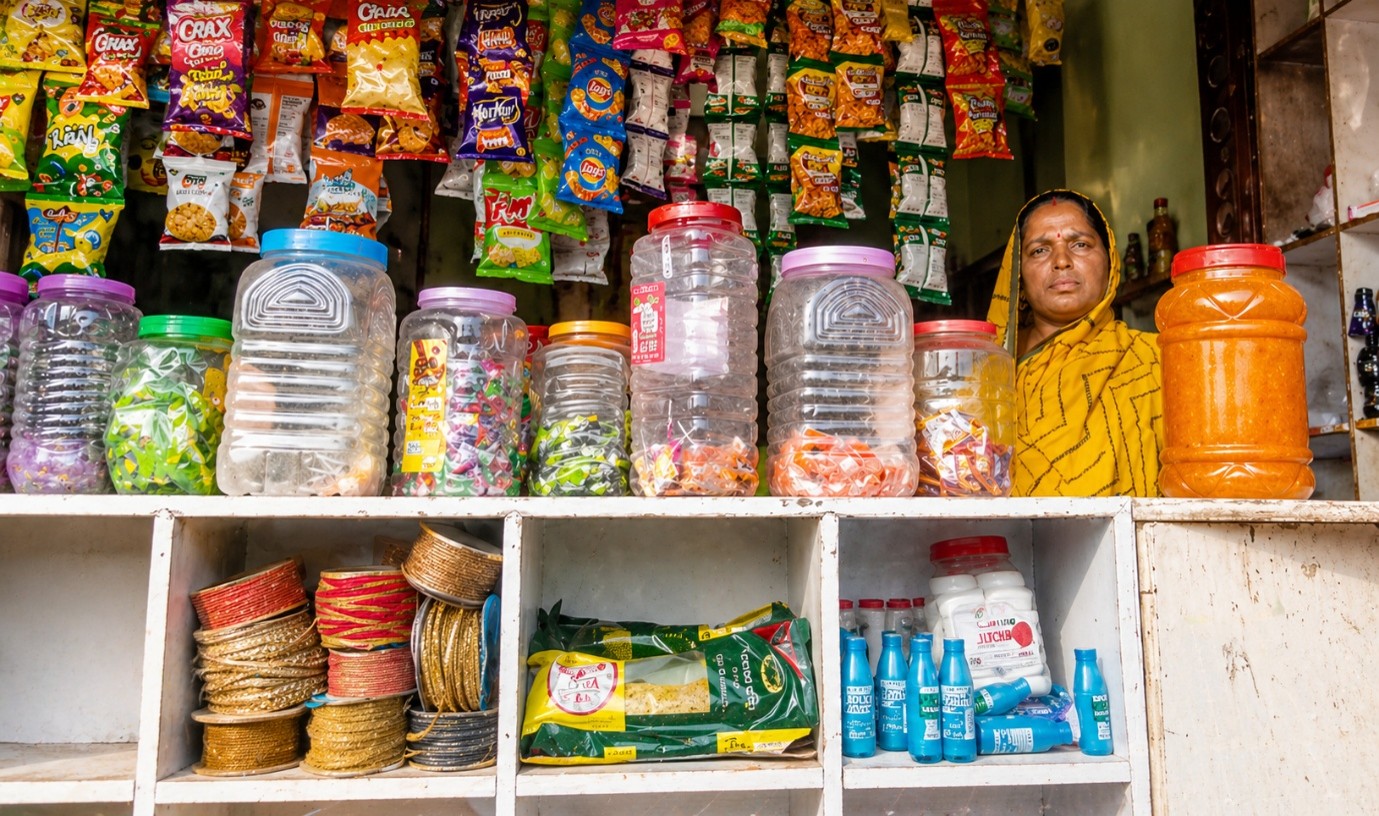
One of the most significant outcomes of the intervention was the establishment of Chanda’s Store as a local sales platform for women engaged in making achar and papad. With reliable power supply and increased customer footfall, Chanda began stocking and promoting these homemade products in her shop. The transformation of Chanda’s General Store into a community marketplace represents a profound paradigm shift in the socio-economic fabric of Rajahi.
By providing dedicated shelf space for homemade goods, Chanda has effectively overcome the traditional barriers that once confined rural women’s labour to the domestic sphere. This model facilitates the disruption of predatory intermediary networks, ensuring women retain the full market value of their labour and immediate liquidity. Furthermore, it formalises the local value chain, transitioning domestic skills into scalable economic assets and granting women a visible stake in the marketplace.
As these economic barriers fall, the impact transcends mere financial gain. The transition of these products from “domestic crafts” to “market commodities” serves as a direct challenge to long-standing patriarchal norms. It helps women transition from marginal observers to valued decision-makers on critical matters such as children’s education and capital investments, proving that when a woman gains economic agency, she doesn’t just change her bank balance; she redefines her status in society.
India’s renewable-energy transition is often described through gigawatts, targets, and capacity additions. Those numbers are essential for understanding the scale of the transition. But on a grassroot scale, it represents more than numbers on an excel sheet.
For Chanda, solarisation did more than keep the lights on. It helped create the conditions in which her enterprise could grow and where her enterprise could, in turn, create space for other women’s work.
The real promise of clean energy lies not only in the power it generates, but in the agency it can unlock.
Because when a woman gains reliable energy for her enterprise, she gains more than electricity. She gains more room to work, more opportunity to earn, and a stronger voice in shaping the future of her family and community.
The Decentralised Energy for Women’s Economic Empowerment (DEWEE) programme connects rural women-led enterprises with decentralised renewable energy solutions to address energy-related barriers to productivity and livelihoods. Implemented through the rural livelihoods ecosystem and focussing on the members of SHGs, the programme combines clean-energy access with women’s enterprise development and economic empowerment.
The author is Shravani Chaturvedi, Consultant- DEWEE, UP, PCI India.