
From Backyard Tanks to Big Dreams
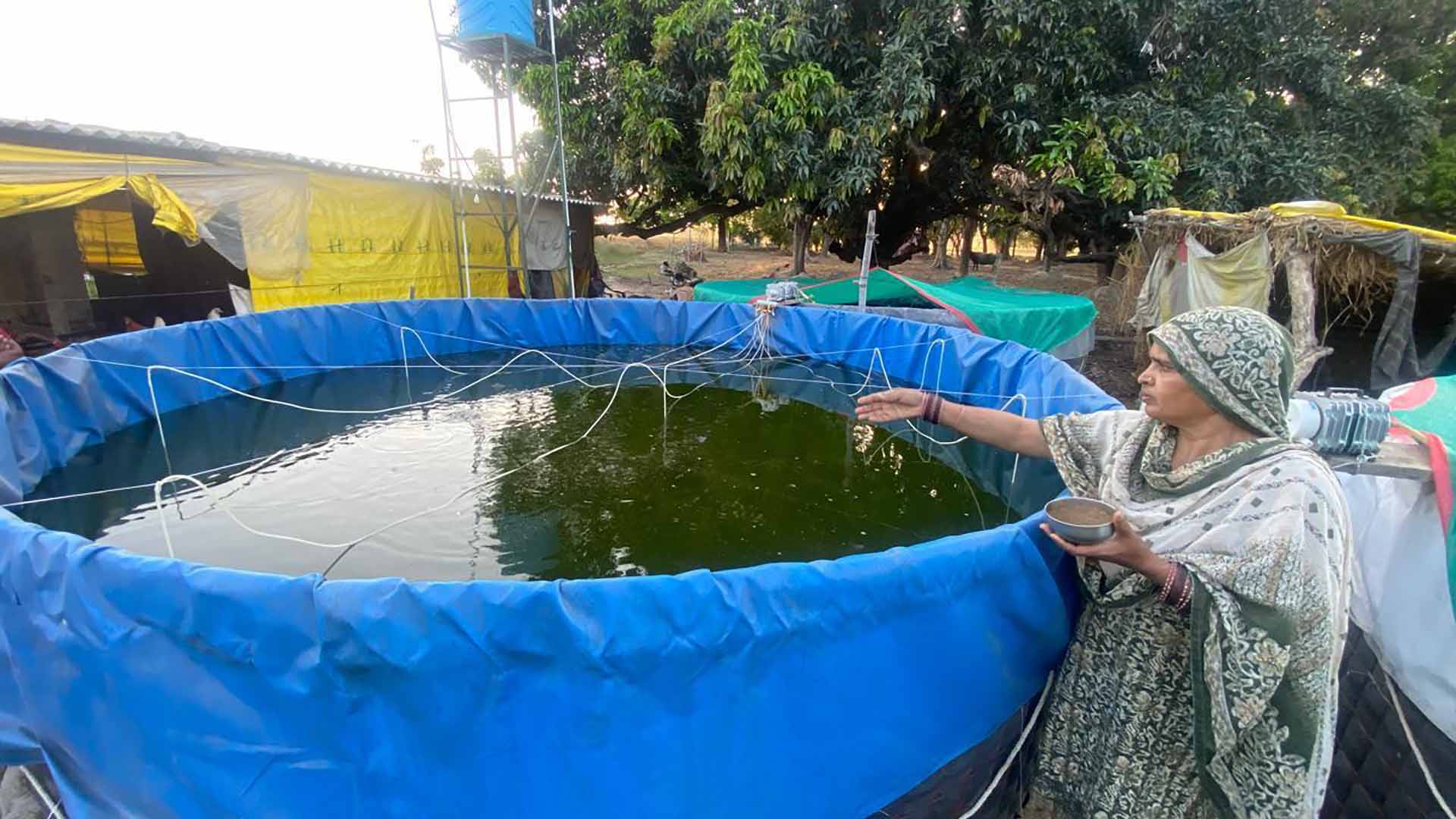
Why women-led fisheries could power India’s next livelihood revolution
When Fardeena Khartoon harvested her first batch of fish, she earned ₹61,000 more than she had ever imagined earning on her own.
For years, she had rarely stepped outside her home in Basti district, Uttar Pradesh. Like many women, her world was defined by household responsibilities and silent constraints. Income generation felt distant. Decision-making, even more so.
Today, she is not just earning. She is leading. And her story is part of a much larger shift quietly unfolding across rural India.
A State with Water, Demand and Untapped Potential
Uttar Pradesh tells a paradoxical story. Fish consumption has grown rapidly, tenfold over the last decade, reflecting changing diets and rising demand. Yet, more than 70% of this demand is still met through imports from other states.
At the same time, the state is endowed with vast aquatic resources – rivers, canals, ponds, and reservoirs covering nearly 1.9 million hectares. And yet, less than a quarter of this potential is fully utilized. This is not just a production gap. It is a missed livelihood opportunity especially for rural women.
A Simple Idea with Transformational Power
What if fish farming didn’t require large ponds, expensive land, or complex infrastructure?
What if it could happen in a backyard? This is where biofloc technology is changing the game. Using compact tanks (as small as 15–20 square meters), women can rear thousands of fish in controlled, high-yield systems. With proper training and support, a single cycle can generate around ₹45,000 in income, with potential to scale further. But the real innovation is not technological. It is institutional and social.
This model works because it brings together multiple systems: Self-Help Groups (SHGs) for mobilisation and peer support, government programmes for subsidies and technical backing, financial institutions for credit access, private sector players for assured market linkages, and capacity-building partners for training and quality control.
Together, they create something powerful: a low-risk, high-confidence pathway for first-time women entrepreneurs. Women are not just beneficiaries here. They are producers, decision-makers, and market participants.
From Learners to “Fishpreneurs”
Sunita Yadav, one of the early adopters, reflects:
“I never imagined I could manage fisheries. Today I contribute equally to household income and decisions.” This shift – from dependence to contribution – is at the heart of the model. Women are trained not just in fish farming, but in water quality management, feeding protocols, disease control, record keeping, and market engagement.
Over time, confidence grows. So does income. Many begin to reinvest—adding more tanks, improving efficiency, and even planning collective hatcheries to reduce input costs. The journey from first harvest to financial independence is no longer hypothetical. It is visible, repeatable and scalable.
More Than Income: A Shift in Power
The outcomes go far beyond earnings, including stronger control over household finances, increased participation in community institutions, enhanced social capital and confidence, and improved nutrition through local fish consumption.
For women like Fardeena, the change is deeply personal: “Today, I am contributing to my family and shaping my children’s future.” This is not just livelihood generation. It is agency in action.
Early pilots have demonstrated strong results:
- ~140 kg fish yield per cycle
- ~70% survival rates
- ₹45,000+ income per tank
- Potential to double income with multiple tanks
With convergence support and learning curves, many women are on track to become “Lakhpati Didis”—earning ₹1 lakh or more annually. What seemed ambitious is now within reach.
Blue Economy Meets Women’s Empowerment
India’s journey toward Viksit Bharat will not be powered by infrastructure alone.
It will depend on productive livelihoods inclusive growth, women’s economic participation, and Biofloc fisheries sit at the intersection of all three.
They contribute to:
- income generation (SDG 1)
- nutrition security (SDG 2)
- gender equality (SDG 5)
- sustainable production (SDG 12)
But more importantly, they show how small, well-designed interventions can unlock large systemic change.
From Water Bodies to Women’s Power
The story of fisheries in Uttar Pradesh is no longer just about supply gaps or production targets. It is about women stepping into new roles. About households discovering new income streams. About communities building resilience from the ground up. And it is about recognizing a simple truth: When women gain access to opportunity, systems begin to work better.
The model has already reached over a thousand women and holds potential for more than 100,000 households. The path forward is clear: deepen convergence, strengthen market linkages, invest in capacity and scale, and continue placing women at the centre. Because the real story is not just about fish. It is about confidence, control, and possibility.
When a woman installs a fish tank in her backyard, she is not just farming.
She is rewriting what is possible – for herself, her family, and the nation.
The author is Syed Mohammad Adeel Abbas, Associate Director – HN and WEE in PTSP project, PCI India