
Dignity – The Tricky Variable in Development Discourse
Why dignity must move to the centre of Women’s Economic Empowerment (WEE) – on metrics, markets, and the things we still don’t know how to measure
Within development discourse, dignity occupies an uncomfortable space. It is widely acknowledged, often invoked in narratives of empowerment, yet rarely treated as a core variable within programmne design or evaluation frameworks.
This is not because dignity lacks importance, but because it resists standardisation. It is difficult to quantify, harder to compare across contexts, and nearly impossible to reduce into a single indicator without losing its meaning.
As a result, dignity is often assumed to be an implicit outcome, something that will follow ‘measurable’ indicators such as income, assets, or access to improved services. However, our work in women’s economic empowerment increasingly suggests that this assumption may be incomplete, and at times, misleading.
In my field experience, dignity does not always follow economic change; sometimes, it precedes it.
Women speak about their first earnings not only in terms of income, but in terms of what that income allows them to feel and negotiate.
One woman shared that for the first time, she could spend money without seeking permission. Another spoke about being addressed with respect at her workplace, something unfamiliar to her earlier. Yet another described being included in household financial decisions, not as a silent presence, but as someone whose opinion mattered.
These are not just personal anecdotes; they signal deeper structural shifts. They reflect a reconfiguration of power – within households, within workplaces, and within the individual’s own sense of self. And yet, these shifts remain largely invisible within the frameworks we rely on to measure progress.
This gap became particularly evident during a recent field visit in Bihar.
Metrics May Miss True Stories
In the context of an urban extreme poverty graduation programme in Bihar, where households are supported through multi-dimensional interventions and assessed against a 12-indicator framework spanning income, assets, food security, and access to services, I met a woman whose story has stayed with me.
She lived in a dense, market-lined informal settlement in Punpun block, Patna. A widow with two young children, she is the sole earner in her household. On paper, she represented what we would call “near success.” She had met most of the indicators but fell short on a few income-related thresholds. She had scored 10 out of 12 and, by the logic of the system, had not yet “graduated.”
But her reality was far less linear than that classification suggested.
She had been running a small kirana (grocery) shop. Recently, however, a larger, better-stocked shop had opened across the street. What appears as routine competition in a market economy, translated into a steady erosion of viability for her. Footfall shifted, sales declined, and her already limited capital nearly stopped circulating.
This was not a failure of effort or intent. It was a shift in market conditions, one that our programme design does not fully account for.
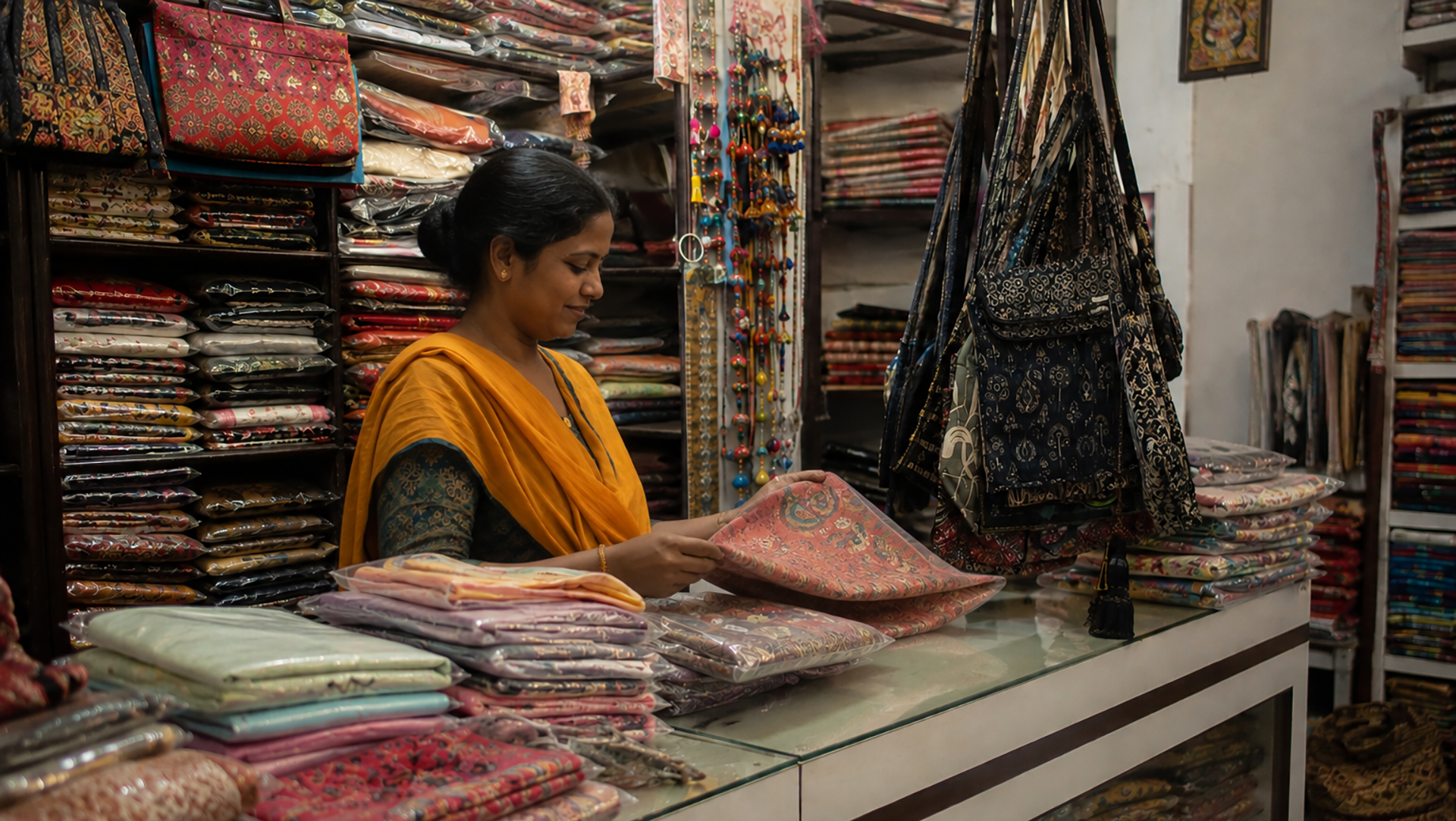
Faced with this, she made a pragmmatic decision. She took up a wage-based job in handicraft shop in the city, earning ₹8,000 per month. It was steady, but it placed her below the programme’s graduation threshold, where income growth and productive asset growth are key indicators. Her shop still exists, but barely functions; in effect, her asset base has nearly disappeared.
And yet, when she spoke about this job, she did not speak about income.
She said quietly, “Didi, wahan bade-bade saheb bhi aate hain… humein ‘madam’ bolte hain, achhe se baat karte hain. Kaam karne ka mann lagta hai. (When educated people from elite, respectable background visit the shop and address me as ‘madam’ I really feel good. The respect and dignity drives me to work there.
There was no performance in her voice, only a steady recognition of something that had shifted.
In a life shaped by precarity and responsibility, she had found a space where she was treated with dignity.
And I remember pausing. By our indicators, she had not made it. Yet it did not feel like she had failed.
This is where the limitations of our frameworks become visible. Development programmes, particularly those focused on women’s economic empowerment, rely on clearly defined thresholds. Income must cross a certain level, assets must accumulate, consumption must improve. These metrics are essential, they enable accountability, comparability, and scale.
But they also assume that transformation is linear, and that material progress adequately captures lived experience.
Dignity Sustains Economic Gains
In reality, especially in urban contexts, economic trajectories are fragile and non-linear. A single market disruption can undo months of effort. In such environments, resilience often lies not just in growth, but in adaptation.
From a system’s perspective, dignity plays a critical role in this adaptation. It is not merely an emotional outcome; it functions as a structural enabler.
A woman who experiences respect in her workplace is more likely to remain, to aspire, and to grow. A woman who feels heard in financial decisions is more likely to influence them. These dynamics directly affect whether economic gains are sustained or reversed.
The challenge, therefore, is not whether dignity matters, but whether our systems are equipped to take it seriously.
Incorporating dignity into development frameworks requires moving beyond purely output-based metrics towards a more layered understanding of change – one that includes perception, agency, and social recognition. While these may not offer the precision of income data, they provide critical insight into the durability of impact.
If development is ultimately about expanding capabilities and freedoms, then dignity cannot remain peripheral.
Because the question is not only whether a woman’s income has increased.
It is whether her position, within her household, within the market, and within her own sense of self has fundamentally shifted.
And that shift, often, begins with dignity.
The author is Koral, Program Manager – Gender, PCI India