Needle, Thread, and a New Beginning
How Chikankari is creating dignified livelihoods for women in Mal Block, Lucknow
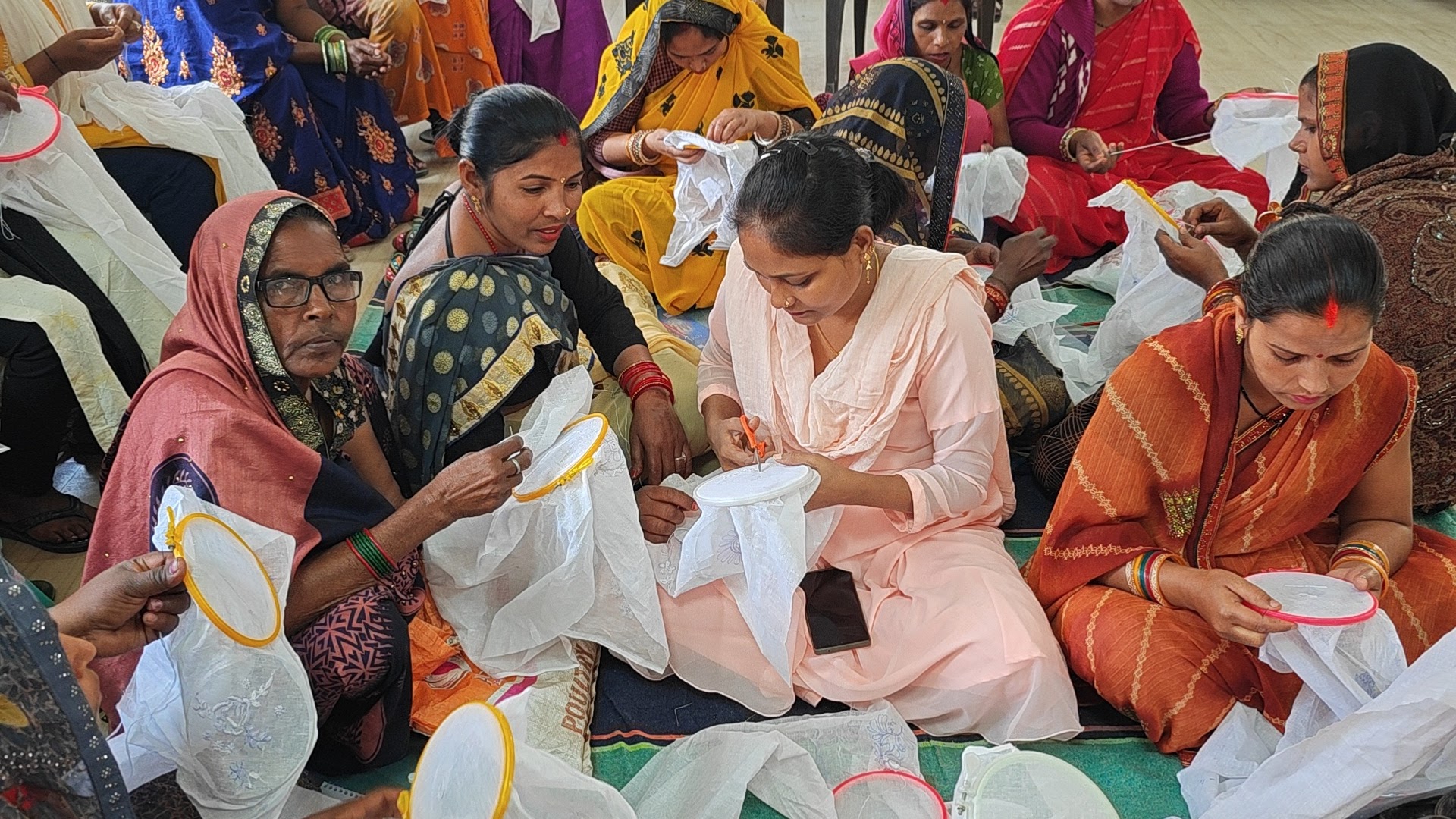
In Mal Block, Lucknow, across five Gram Panchayats, a quiet but significant transformation has been unfolding. Thirty-two women from households enumerated under the Zero Poverty Abhiyan picked up a needle and thread for the first time as aspiring professionals and underwent training. Soon after, they collectively completed over 100 kurtas and began earning a real, additional income through a craft that has defined Lucknow for centuries – Chikankari.
The Zero Poverty Abhiyan is a dignity-focused, technology-driven state initiative that precisely targets the poorest households in Uttar Pradesh and works to raise their minimum annual income to at least ₹1.25 lakh through a combination of Direct Benefit Transfers (DBTs) and customised livelihood support. Its approach is sequenced – social protection schemes first target every family member and the household, and only once that foundation is secured does the focus shift towards livelihoods. PCI India provides technical assistance to the Government of Uttar Pradesh in rolling out this flagship convergence programme.
This sequencing is intentional. The Chikankari income these women are now earning is not survival money. It is growth money, earned on top of a protection floor that the state has already put in place.
Not Charity but Craft
That framing mattered. Despite the protections the Abhiyan had put in place, a significant portion of women in these households remained economically inactive, caught in what development practitioners call the “double burden” of childcare and domestic management. The work available to them outside the home was seasonal, inconsistent, and physically demanding.
The workshop was designed not just to teach stitches but to shift how these women saw themselves and their work.
Over two days, these 32 women learnt some foundational stitches and beyond. They learnt motif development, and how to sketch a design on tracing paper, perforate its outline with a needle, and transfer the pattern onto fabric. The ink was prepared by hand: indigo powder mixed with glue and kerosene oil, dabbed through the pricked paper to leave a clean impression on the fabric, a guide for where the needle would follow.
It was technical. It was precise. And for many of them, it was the first time their hands had been recognised as skilled.
A Model Built on Trust
Skills without income are just workshops. The Zero Poverty Abhiyan ensured this one was different. Before the training concluded, the programme had already secured a market linkage with Thread Craft India, a Lucknow-based industry partner. Thread Craft India agreed to supply raw material, kurtas and other garments, directly to the group, who would embroider them with Chikankari and return the finished pieces.
But what about collection and distribution? The group elected one woman from among themselves as the Group Coordinator, not appointed from above, but chosen by her peers. Her responsibilities included travelling to the Thread Craft India facility, collecting the raw materials, and distributing them equitably across the group.
For this additional responsibility, she earns 5% of the total revenue generated by the group — a financially rewarding leadership role within a community of women who rarely hold either.
Real Women, Real Earnings
Soon after the training ended in February 2026, the cohort had collectively completed over 100 kurtas, not by working full days but by weaving the craft into hours that already existed: early mornings, afternoons between household tasks, evenings by lamplight.
The numbers speak quietly but clearly. Nanhakka from Roodan Khera has emerged as the group’s most prolific artisan, earning ₹2,600 in her first month from a few hours of work a day. Pinki, also from Roodan Khera, is close behind at ₹1,700 and Richa, her neighbour in the same village, has earned ₹1,600.
Top of Form
Bottom of Form
Three women, one village, nearly Rs. 6,000 in additional household income in their first month, and this is only the beginning.
Consider what that income sits alongside. For families like theirs, the basic floor is already secured by the state through various schemes. Chikankari adds independent, skilled, self-earned income — the kind that builds confidence as much as it builds savings.
Chikankari rewards practice, and with every kurta completed, both the quality and the pace of their work improves.
For women who were previously limited to back-breaking seasonal labour, integral members of households that the Abhiyan had already worked hard to protect, these numbers represent something more than income. They represent a new kind of work: home-based, skilled, clean, and dignified. With this additional income and the recognition that comes with being an artisan, it is hoped they will claim not just better earnings but a better standing, in their households and in their communities.
Why this Model Works
What makes this initiative replicable is its simplicity and honesty. It does not promise transformation overnight. It promises something more practical: a few hours of skilled work, a direct connection to buyers, and a fair return.
- A foundation of social protection first: The Abhiyan ensures families are covered under the schemes they are entitled to before livelihood support begins. The Chikankari income is built on top of that foundation, not in place of it.
- A real skill taught seriously.
- An immediate market, not a promise.
- Community-led coordination.
- Work that fits real lives: Chikankari requires no commute, no fixed shift, and no expensive equipment. It belongs in the home, which for these women is exactly where livelihood support needed to begin.
With over 100 kurtas completed soon after the training and real earnings already in hand, the proof of concept is clear. The next step is scale: more blocks, more women, more Gram Panchayats, with the same honest model. Secure the social protection floor. Teach a real skill. Connect to a real market. Trust women to lead the rest.
The needle is already moving. The thread is already pulling. In Mal Block, Lucknow, a stitch at a time, something is changing, and this time, it is built to last.
The author is Urminder Singh, Consultant, Zero Poverty Abhiyaan, PCI India