
When Mothers Earn, Daughters Dream Bigger
The power of women’s economic empowerment in shaping future generations
Every daughter is a mirror — reflecting not just her mother’s face, but often, her mother’s fate. For generations, that reflection has been bound to kitchens, household chores, and quiet endurance.
But when mothers step into economic power, daughters begin to outgrow limitations and start inheriting possibilities.
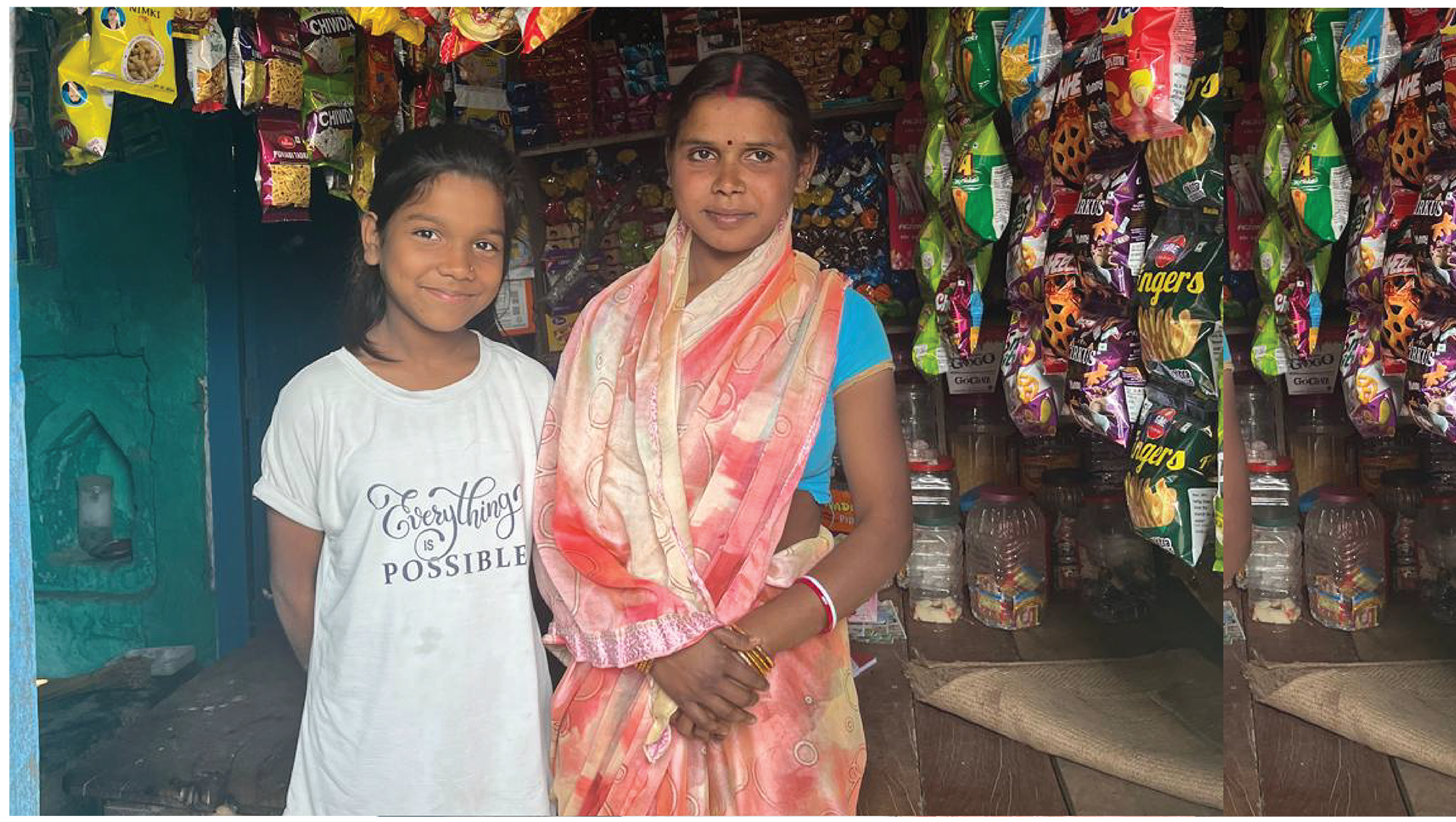
In Mokama, a small town in Patna district, I met Aarti Devi, a quiet woman in her late thirties whose life once revolved around managing scarcity in urban lanes that promised opportunity yet often delivered paradox. A homemaker with four children, she relied on her husband’s meagre income from street vending. In the narrow lanes where she lived, every rupee was stretched, every meal carefully measured, and every dream quietly postponed.
A Program that Powered Aspirations
Her life started to shift when Aarti was selected under the SJY Urban program, a flagship initiative of the Government of Bihar. With a small livelihood grant, she opened a kirana shop outside her home. To an outsider, it looked like an ordinary corner store —shelves stacked with oil packets, biscuits, and soap bars. But for Aarti, it was her first step toward independence.
Her eldest daughter, Anjali, a grade 6 student with a bright mind and curious eyes, now began helping her — no longer in the kitchen, but at the shop counter. She started maintaining accounts, scribbling sales in her school notebook. One evening, as Aarti recounted shyly, her daughter corrected her math, teaching her to calculate profit margins.
It was a small, almost tender moment: where once the mother had taught her daughter to knead dough, now the daughter taught her mother to count change.
Every evening, they sat side by side, with the mother learning from the daughter, and the daughter learning from her mother. In those moments, poverty didn’t disappear, but a ray of possibility appeared.
When I asked Anjali what she wanted to be when she grew up, she answered without hesitation: “Scientist.”
The Multiplier Effect
Aarti’s earnings changed her family’s income, but more importantly, they changed her daughter’s imagination. When a girl sees her mother make decisions, handle money, and earn respect, her understanding of what is “possible” begins to expand.
Economists call this the multiplier effect of women’s empowerment. In households where mothers earn, daughters are statistically more likely to pursue higher education and delay early marriage. Evidence from India and around the world shows that women’s income doesn’t just raise household welfare, it reshapes aspirations across generations.
This is why women’s work is not charity — it is sound economics and social progress.
As B. R. Ambedkar once said, “I measure the progress of a community by the degree of progress which women have achieved.”
When women are held back, societies stagnate. But when they are empowered, entire communities begin to move forward.
Programs like SJY Urban remind us that transformation doesn’t always come from massive factories or billion-dollar schemes. Sometimes, it begins quietly, in a single household, with a mother opening a small kirana shop and a daughter daring to dream of becoming a scientist. In homes like Aarti’s, reflections are no longer of women confined to kitchens, but of earners, decision-makers, and dreamers.
And when millions of such reflections begin to change, when daughters across India start seeing ambition instead of limitation, the trajectory of a nation quietly shifts.
This season, as we celebrate festivals and set for welcoming the new year, I am reminded of women like Aarti, quietly illuminating their homes and communities in their own way. Through programs like SJY Urban, women across Bihar are building livelihoods that bring both income and dignity. Each step they take toward economic independence adds a steady, lasting light to their families’ futures—one that continues to shine longer, even after the festive lamps fade.
The author is Koral, Program Manager – Gender, at PCI India