
Leveraging Plastic Waste Recycling by Rural SHG Enterprises
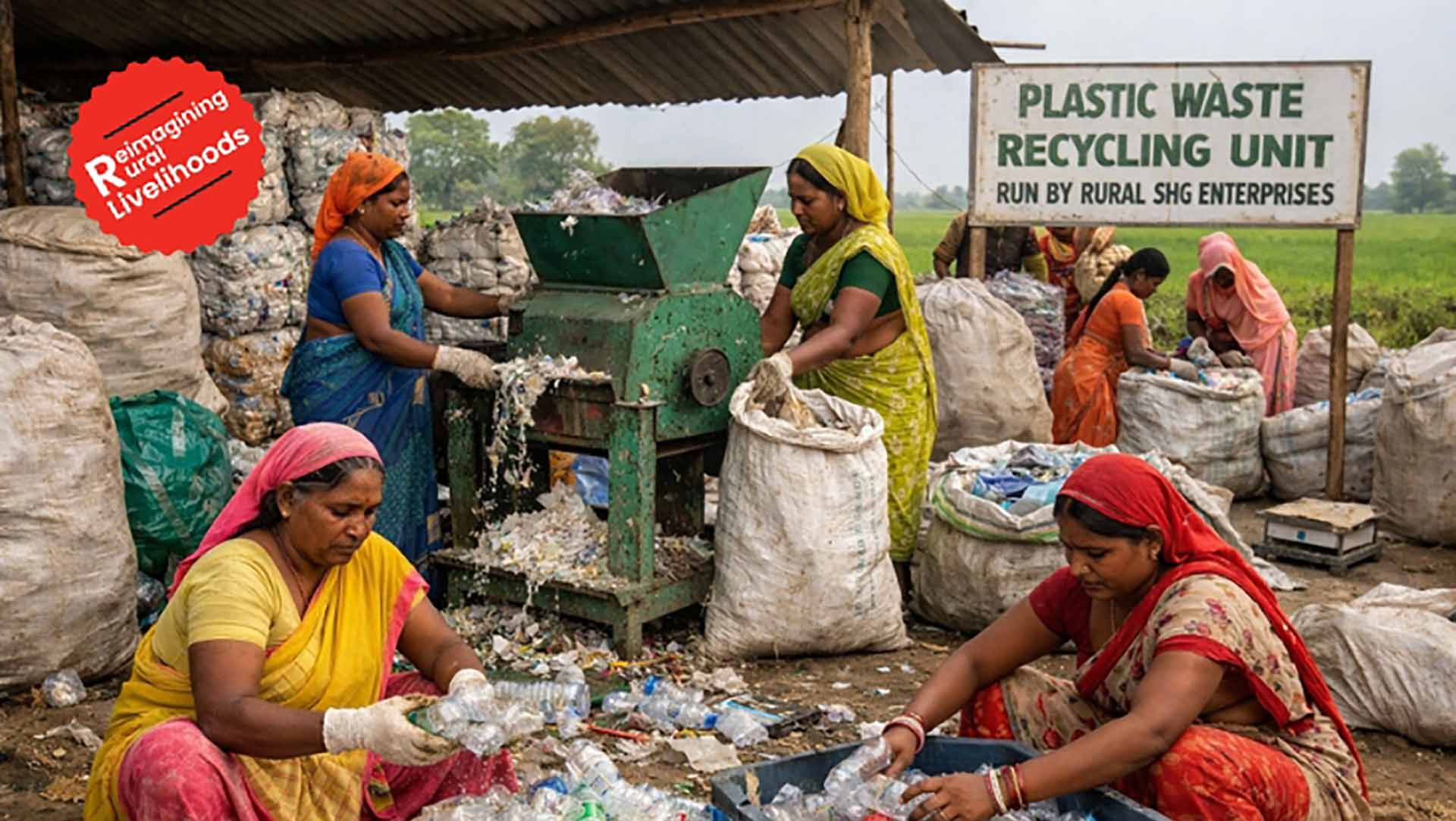
By leveraging SHG enterprises, rural India can transform plastic waste into opportunity. Decentralised recycling models offer a scalable pathway to build livelihoods while advancing a circular economy.
India’s large population of around 1.46 billion translates into extremely high consumption levels, with plastics in diverse forms comprising a significant component of everyday use. According to the Central Pollution Control Board (CPCB, 2022), nearly 3.5 million tonnes of plastic waste is generated annually in India. Of this, only about 60% is collected and 50% recycled. The remaining, uncollected plastic waste clogs waterways, degrades farmland, and adds to greenhouse gas emissions.
India’s current plastic recycling and management system is largely urban centric. With around 63% of population residing in rural areas, the volume of plastic waste generated through packaging, single-use products and agro-plastics is substantial and growing, thus posing serious threats to soil and water. In this context, Self-Help Groups (SHGs) and rural youth can play a transformative role in local plastic waste recycling and management while also creating sustainable livelihoods.
The Scope
With over 8.6 million SHGs federated under DAY-NRLM and nearly 100 million women members, a strong institutional base already exists to anchor micro-enterprises in waste management. Experiences from states such as Kerala and Tamil Nadu show that SHGs engaged in plastic segregation, shredding, and repurposing can generate stable incomes while keeping villages clean. For example, shredded plastic is now being used in rural road construction under the Pradhan Mantri Gram Sadak Yojana (PMGSY), where adding 8% plastic waste to bitumen improves road durability and reduces costs.
A typical SHG unit with 10–12 women members employed in collection, sorting and value addition can easily process 1 tonne of plastic per month and earn INR 30,000–40,000 in revenue. Now if we scale this across just 10% of existing SHGs, this will mean mobilising over 8 lakh women and recycling of more than 1 million tonnes of plastic annually, thus creating significant environmental and livelihood impacts at scale.
PCI India has a vision to enhance Circular Economy potential of rural India. The current environment and recycling policies are aligned, for example India’s Extended Producer Responsibility (EPR) rules (2022) mandate recycling targets for producers and brands PCI India has models ready to create women-led recycling enterprise. Having strong partnerships with the National Rural Livelihoods Mission (NRLM) and various State Rural Livelihood Missions, PCI India seeks to collaborate with industry and CSR partners to support tie-ups including incubation support to SHG enterprises and resources for technology boost, market linkages, exploring credit schemes under PMEGP.
The approach also includes establishing Rural Enterprise Development Hubs (REDHs) to strengthen aggregation, processing, and last-mile market connectivity.
PCI India’s vision is to transform a pressing environmental challenge into local, economic opportunity, where rural SHGs can pioneer a women-led, climate-smart recycling ecosystem that benefits communities and the planet alike.
The author is Shantamay Chatterjee, Director – Livelihood with WEE, PCI India, and this is part of his blog series titled “Reimagining Rural Livelihoods: From Subsistence to Sustainability”.