
Access to Clean Energy for Marginal and Small Farmers- Gap and Unfulfilled Dreams
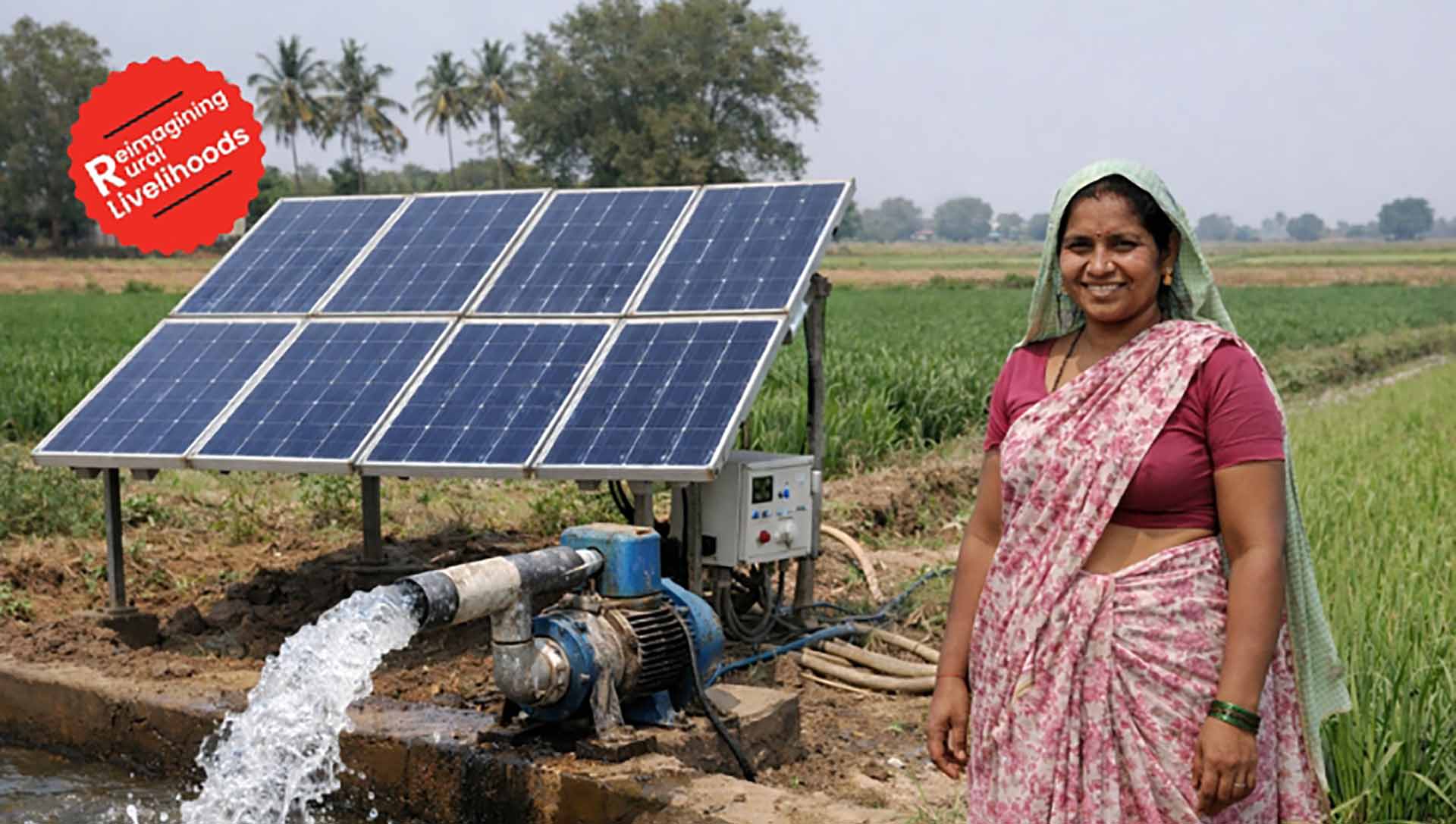
Inclusive financing, decentralised renewable energy models, and SHG-led collective solutions are essential to bridge the gap between access and adoption of climate-resilient agriculture among small and marginal farmers in India.
There is a significant scope to bridge the gap between the adoption of clean energy solutions and their accessibility among small and marginal farmers in India. This will positively impact both agricultural productivity and environmental sustainability. While India is making rapid progress toward a national renewable energy target; renewable-based electricity generation capacity stood at 234.34 GW (46.3% of total installed capacity by August 2025), the penetration of clean technologies at the grassroots level remains uneven, especially in farming communities that need them the most.
Data on Clean Energy and Indian Agriculture
India’s agricultural sector employs more than half its population, but the majority (85%) are smallholder and marginal farmers managing less than 2 hectares of land while accounting for around 50% of farm yield. For irrigation and mechanization, these farmers heavily rely on diesel and grid electricity, and with over-use of water — particularly ground water, due to lack of knowledge & irrigation access — these farmers bear sufficient financial and environmental losses, not just for themselves but also for the country. Diesel pumps are heavily used in pumping water to fields and account for up to 12% of India’s annual diesel consumption, with fuel costs constituting 20-40% of total input costs for farmers. This over-reliance not only increases production expenses but also results in lower yields and irregular income.This also reflects as per data by the PM-KUSUM Guidelines (July 2019), Ministry of New and Renewable Energy (MNRE), Government of India.
Key Opportunities
- Out of approximately 30 million agricultural pumps in use, at least 10 million (over 33%) are diesel-powered, a major cost and pollution source for marginal farmers. There is a sizeable opportunity to covert them into clean energy alternatives.
- Less than 1% of all agricultural pumps currently use solar power, thus offering scope for smallholders to switch from grid electricity (often unreliable) or expensive diesel fuel to clean energy.
- Till 2024, about 380,000 solar pumps were deployed nationally. These is a huge potential here, as tens of millions of farmers can be offered cleaner, cheaper energy sources for irrigation. There is an estimated gap of more than 29 million units.
- Current government schemes and subsidies are mostly availed by middle and large landholders and private firms, including startups. Currently as available data indicates, most installed solar pumps are of higher capacity (over 2 HP), which only serves about 32% of farmers (owners of more than 1-2 hectare). Smaller (micro) solar pumps, suitable for 68% of India’s marginal farmers, remain far less promoted and deployed.
- Up to 15-30% of smallholders’ produce is lost due to lack of access to affordable, reliable energy for irrigation, storage and processing.
Schemes, such as PM-KUSUM, have aimed to promote solar irrigation solutions and replace diesel with solar-powered pumps. Till 2024, about 0.5 million solar pumps have been installed, predominantly in Haryana, Maharashtra, and Rajasthan with support of state missions and diverse projects. However, we have a long way to go as 30 million farmers are still using diesel pumps.
Visible Energy Poverty and Rural Impact
- Over 240 million rural Indians lack reliable access to electricity, with grid extension projects often failing to reach remote farms.
- Small and marginal farmers spend up to 40% of their input costs on energy, with fluctuating diesel prices impacting profitability and sustainability.
- Government initiatives like a 60% subsidy for solar water pumps exist, but the remaining upfront cost is still too high for marginal and small holders, who are mostly women.
Solutions – The Way Forward
The energy input cost remains the largest barrier to farm growth for marginal and small farmers, forcing them to rely heavily on loans for accessing diesel or grid powered pumps and thereby failing to transit to diverse climate resilient technologies and methods. Transition to Decentralised/ Distributed Renewable Energy (DRE) for pumps is largely unaffordable despite subsidies, unless credible financing, at low interest rates and models, are created. For instance, the Joint Management Group (JMG) that assist a group of farmers access credit & schemes to install DRE. SHGs and FPOS can help create JMGs to access DRE solutions. JMG can easily use pay-per-use DRE solutions which would help overcome the upfront cost problem.
Farmers need to be trained on scientific water use and empowered to access solar-powered services for irrigation and milling, thereby reducing energy costs by about 30-60% compared to diesel. PCI supported projects in Haryana and Uttar Pradesh have credibly indicated that clean energy adoption leads to quantifiable savings in production. Solar pumps associated with scientific water use can cut irrigation costs by up to 90%, freeing resources for other inputs and improving climate resiliency. This would further enable reducing GHG and synced with diverse climate resilient methods like AWD in rice farming and agri-waste recycle can further add to farm income.
Conclusion
PCI India strongly believes that DRE based solution backed by policy momentum and technological innovation can close the clean energy gap, thereby substantially reducing the affordability and accessibility gaps for small and marginal farmers through curated models that can easily go to scale. Bridging this gap require more inclusive financing and training models which SHG platforms can provide given the presence of women being near to 70% among farmers, supportive regulation and targeted outreach. With affordable climate resilient technologies, scalable operations model and zeroing down on GHG emission in agriculture; India’s agricultural economy can transform within 5-10 years and ensure sustainable communities.
The author is Shantamay Chatterjee, Director – Livelihood with WEE, PCI India, and this is part of his blog series titled “Reimagining Rural Livelihoods: From Subsistence to Sustainability”.