Notification: PCI India has successfully migrated from pciglobal.org to pciglobal.in. All emails received from our new domain pciglobal.in are to be treated as undisputed origin.
- About Us
- Our Work
- Health and Nutrition
- Gender, DEI and Social Norms
- Women’s Economic Empowerment and Livelihoods
- Technical Support Unit for JEEViKA
- Cloud Kitchen
- Leveraging Public Procurement for WEE
- Technical Assistance to UPSRLM – Fishery Project
- Technical Assistance to UPSRLM – Beekeeping Project
- Udyamita
- Hunar: Pathways to Progress
- Go-HRM
- Technical Assistance to the Rural Development Department
- SAFAL I
- SAFAL II
- SAFAL III
- STREE
- BUPGP – SJY Urban
- Zero Poverty
- Weave Plus
- Swabhiman
- Migrant Cell
- SENU – GIZ
- Glasses for Livelihoods
- Take Home Ration
- Public Procurement
- Climate Action
- Social and Environment Protection
- Emergency Response
- Skilling & Employability
- Our Expertise
- PCI Research
- Intersection
- Events
- Resources
- Get Involved
- SSE

- About Us
- Our Work
- Health and Nutrition
- Gender, DEI and Social Norms
- Women’s Economic Empowerment and Livelihoods
- Technical Support Unit for JEEViKA
- Cloud Kitchen
- Leveraging Public Procurement for WEE
- Technical Assistance to UPSRLM – Fishery Project
- Technical Assistance to UPSRLM – Beekeeping Project
- Udyamita
- Hunar: Pathways to Progress
- Go-HRM
- Technical Assistance to the Rural Development Department
- SAFAL I
- SAFAL II
- SAFAL III
- STREE
- BUPGP – SJY Urban
- Zero Poverty
- Weave Plus
- Swabhiman
- Migrant Cell
- SENU – GIZ
- Glasses for Livelihoods
- Take Home Ration
- Public Procurement
- Climate Action
- Social and Environment Protection
- Emergency Response
- Skilling & Employability
- Our Expertise
- PCI Research
- Intersection
- Events
- Resources
- Get Involved
- SSE
Background
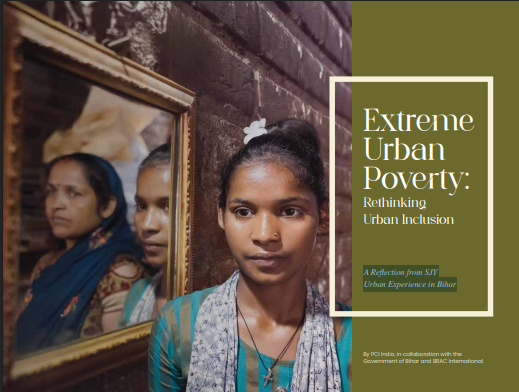
Urban poverty in India is increasingly complex, marked by insecure livelihoods, limited access to basic services, and vulnerability to systemic shocks. Within this landscape, ultra-poor urban households face the harshest realities—living in overcrowded slums, lacking legal identity, and struggling daily for food, health, and dignity.
Recognizing this urgent need, the Bihar Urban Poor Graduation Program (BUPGP) was launched to enable sustained pathways out of extreme urban poverty in Patna and Gaya districts.
Scope of Intervention
BUPGP follows the globally tested Graduation Approach, built on four foundational pillars—social protection, livelihood promotion, financial inclusion, and social empowerment. The program aims to reach 5,000 ultra-poor households across 676 wards in 27 Urban Local Bodies (ULBs), supporting them toward long-term socio-economic resilience and self-reliance.
Program Lead & Collaborators
Anchored under the Satat Jeevikoparjan Yojana (SJY) – Urban, the program is implemented by JEEViKA (Bihar Rural Livelihoods Promotion Society) under the Department of Rural Development, Government of Bihar, with technical support from BRAC International through a dedicated Project Management Unit (PMU) led by PCI India.
The program is a collaborative effort. It is:
- Implemented by JEEViKA, Department of Rural Development, Government of Bihar
- Technical support by PCI India-led Project Management Unit (PMU), supported by BRAC International
- Technical partners under PMU – Aga Khan Foundation, Mobile Creches, Mahila Housing Trust
- Closely coordinated with Urban Local Bodies (ULBs), Municipal Corporations, and various government departments and private sector partners.
What We Did
To address the multidimensional nature of urban poverty, BUPGP is structured around below mentioned key interrelated components:
- Community Capacity Development:
This component focuses on enhancing the capabilities of all key stakeholders, including ultra-poor households, Master Resource Persons (MRPs), and program staff. Core activities include:
- Designing and delivering tailored training curricula for households, MRPs, and staff.
- Developing modules, manuals, and toolkits on themes such as livelihoods, life skills, financial literacy, gender equity, climate resilience, and HNS
- Establishing a feedback-driven support mechanism to ensure adaptive learning
- Urban Livelihoods Ecosystem Development
The program focuses on identifying diverse, viable, and aspiration-aligned income-generation pathways for ultra-poor households ranging from self-employment and service-based trades to participation in the gig economy and access to placement-linked wage employment. Key activities include:
- Identify market-aligned livelihood opportunities based on household skills and interests.
- Develop a supportive livelihood ecosystem through partnerships with municipal bodies, industries, and training institutions.
- Facilitate transfer of productive assets or skills as per household-level microplans and market potential.
- Deliver customized skilling and livelihood solutions tailored to urban economic demands.
- Access to Entitlements and Services
The program adopts a convergence-based model, aiming to integrate government schemes and entitlements to ultra-poor households. Key activities include:
- Facilitate inter-departmental convergence with designated government departments to streamline access to schemes and services.
- Mobilize Master Resource Persons (MRPs) to support households in identifying and enrolling in relevant schemes and programs.
- Build household awareness and confidence through continuous handholding, enabling informed and independent access to entitlements.
- Program Management Support
Key activities include:
- Support the SJY program in strengthening MIS for data-driven decision making
- Intra-departmental coordination for effective program execution.
- Enable inter-departmental coordination with key government stakeholders (e.g., Municipal Corporation, UD&HD, Social Welfare Department).
Outcome
- 90 Master Resource Persons (MRPs) trained across Patna and Gaya to support ultra-poor households.
- Tailored training curricula developed and rolled out on financial literacy, life skills, gender, HNS, and climate resilience.
- Over 2,700 households received Special Investment Fund (SIF); 89% invested in livelihood activities.
- Microplanning completed for all participating HHs; 63% initiated their chosen livelihood path. 42% of the households have received LIF (Livelihood Investment Fund) to start their business.
- Formal and non-formal skilling plans activated based on youth profiling; gig economy and enterprise-based models introduced with more than 75 youths getting trained.
- Vendor license facilitation initiated for 278 HHs; letters sent to ULBs for recognition of cart-based vendors.
- 3000+ HHs linked to various government entitlements.
Monitoring & Evaluation
The key objective of the BUPGP is to enhance the quality of life and improve the economic and social empowerment of ultra-poor urban households in Bihar. The program’s outcomes will be assessed through measurable indicators, including:
- Increase in household income and savings
- Increase in productive assets for the participating households.
- Improved access to basic services such as drinking water, sanitation, clean energy, immunization, and education
Improved access to social protection, food security, and health insurance (PMJAY)