More Than a Meal
Why community-led nutrition programmes are outpacing top-down strategies. Moving beyond simple food distribution, this is how Self-Help Groups and local collaborations are creating sustainable solutions to child malnutrition in India.
For decades, the narrative surrounding child malnutrition in India has often been one of deficit and distribution. The challenge is vast, and the conventional solution has been, logically, to distribute resources. We provide food packets, supply fortified grains, and deliver vitamin supplements. These actions are vital, lifesaving, and form the backbone of our national safety nets.
But as development professionals, we must ask the harder question: If distribution alone were the answer, would we not have solved the problem by now?
The reality on the ground is far more complex. A packet of fortified cereal, though crucial, does not teach a new mother why her child needs a diverse diet. It doesn’t address the social norms that might prevent her from accessing healthcare, nor does it solve the water and sanitation issues that lead to repeated illness, cancelling out any nutritional gains.
This is where the “top-down” model, while well-intentioned, reveals its limitations. It treats the symptom—hunger—without always curing the disease—the complex web of social, economic, and educational barriers that cause malnutrition.
The solution we are finding is not just in what is delivered, but in how it is delivered. The future of nutrition is not being handed down; it is being built from the ground up by the communities themselves.
The Power Shift: From Passive Recipients to Active Owners
At PCI India, our work is a daily testament to this shift. The most profound and sustainable changes we see are not in areas where we are simply the providers, but in areas where we are the facilitators. The true engines of this change are the community institutions, particularly Self-Help Groups (SHGs).
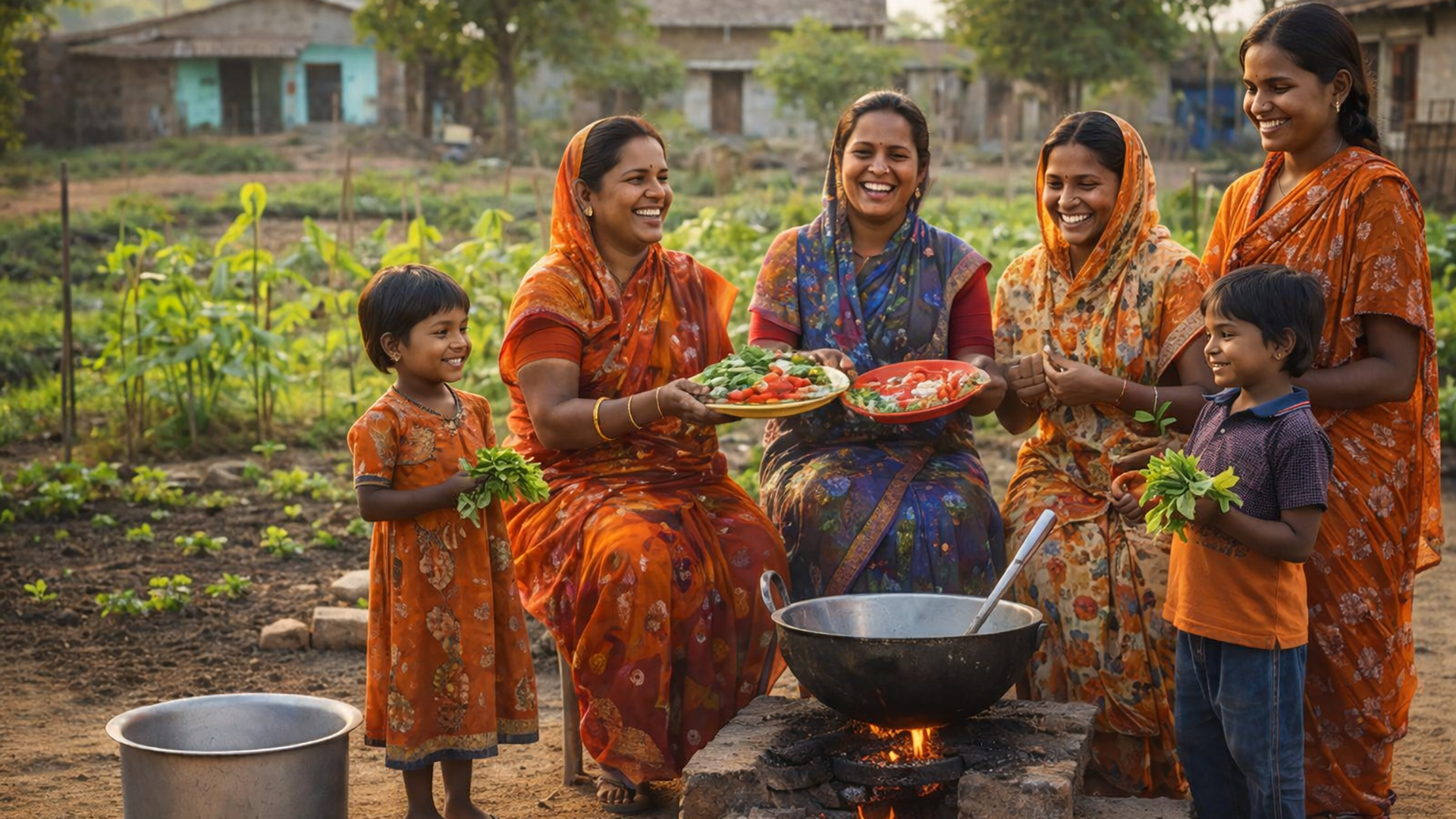
When an SHG, a trusted group of women from the community, takes ownership of the nutrition challenge, the entire dynamic changes. A health message is no longer an external directive; it’s a conversation between neighbours. A cooking demonstration is no longer a top-down lesson; it’s a shared act of learning and support.
These women are not just “beneficiaries.” They are leaders, planners, and first-line problem-solvers. They are the ones who can identify the most vulnerable child in their village without needing a dataset. They are the ones who can blend traditional recipes with new knowledge on micronutrients, making nutrition relevant and affordable.
A Holistic Ecosystem
This community-led philosophy is what “more than a meal” truly means. It’s an ecosystem of solutions, not a single-point intervention.
When an SHG leads a nutrition programme, they don’t just talk about food.
- They advocate for clean drinking water and sanitation, understanding the critical link between hygiene and health.
- They champion the creation of poshan vatikas (nutri gardens), empowering families with direct, low-cost access to fresh vegetables.
- They connect nutrition to livelihoods, perhaps by managing a community kitchen or a small-scale poultry enterprise, which both feeds their children and empowers them economically.
This is the inter-sectoral solution in its purest form. It’s Health, Women’s Economic Empowerment, and Gender equity all converging at the village level.
An Inspiring Story from the Field
I recall a community meeting in a remote village. The local Anganwadi worker was struggling with low attendance at her monthly health talks. The solution? We partnered with the local SHG. Instead of a one-way lecture, the SHG leaders re-branded the event as a “Healthy Baby Competition” and a “Nutritious Recipe Exchange.”
Suddenly, the meeting was full. Mothers came to share, learn, and celebrate. They discussed the colour and diversity of their children’s plates, and the SHG provided a small prize—a packet of seeds for a kitchen garden. In one afternoon, they transformed nutrition from a chore into a celebration. That is the power of community ownership.
The Way Forward
The challenges we face—be it malnutrition, poverty, or climate change—are too complex for any one organisation to solve. Top-down strategies will always have a role, but their power is amplified a hundred-fold when they are used to fuel, not replace, community-led action.
The most inspiring stories in our sector are not about us. They are about the resilience, creativity, and boldness of the communities we partner with. Our job is to listen, to collaborate, and to get the resources into the hands of those who know how to use them best. Because true, sustainable change is always more than just a meal.
The author is Saikat Roy, Digital Marketing Consultant (Kolkata), Heshel, PCI India